


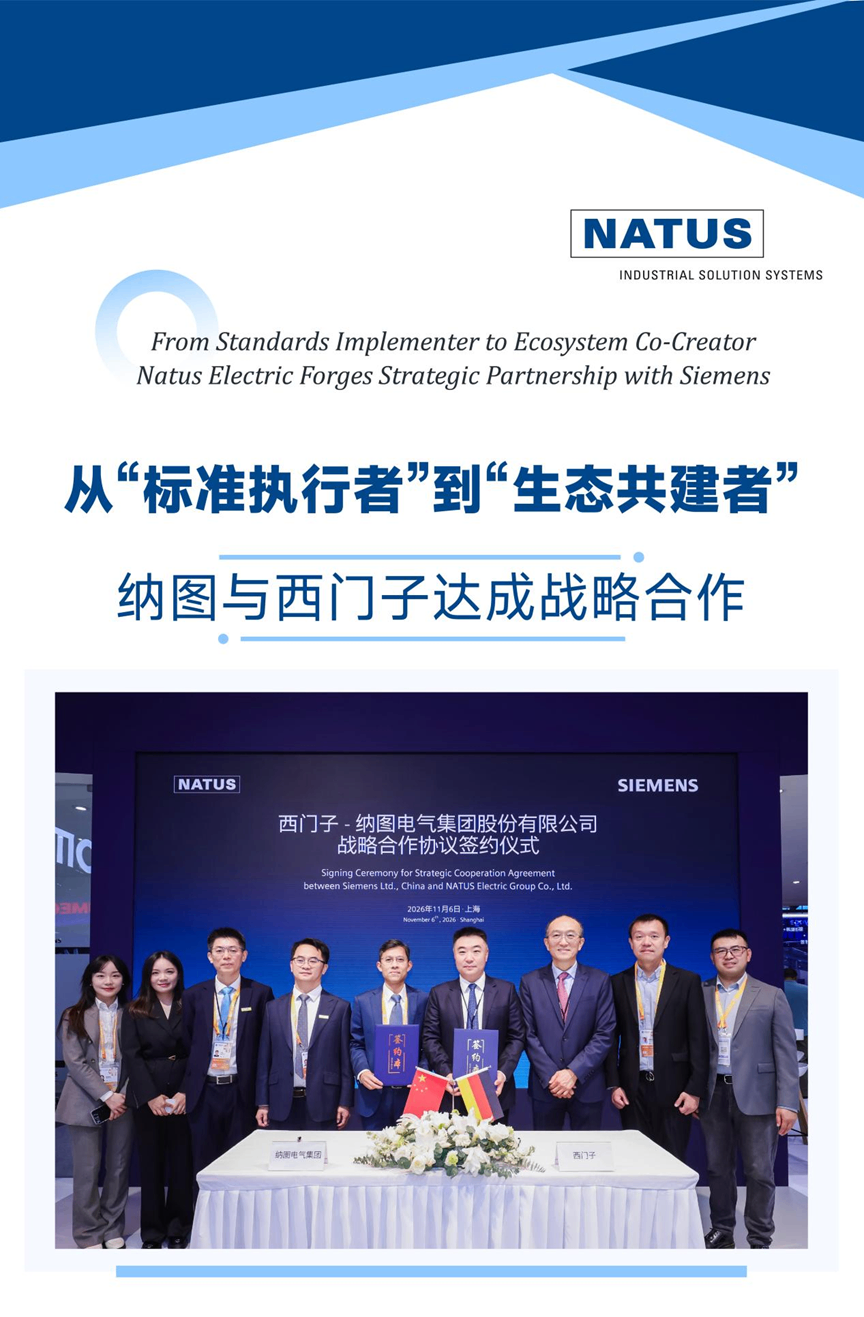
On November 6, 2026, the 9th China International Import Expo (CIIE) was held at the National Exhibition and Convention Center in Shanghai. At the Siemens booth, NATUS Electric Group and Siemens formally signed a strategic cooperation agreement.
For NATUS Electric Group, a long-standing “Diamond Partner” of Siemens, this is not merely a confirmation of status — it marks a comprehensive elevation of the relationship from supply chain collaboration to “ecosystem co-building” focused on frontier tracks such as AI computing, semiconductors and zero-carbon parks.
01 | Groundwork: A Top-Tier Ecosystem Position and a “Top Score”
Within Siemens' vast global ecosystem network, “Diamond Partner” represents the highest level of strategic mutual trust and business alignment.
The ability to hold this position steadily stems from NATUS's deep underlying manufacturing strength. In early 2026, in Siemens' new annual ICP (Integrated Control Cabinet) partner certification, NATUS passed with the highest score. Under Siemens' stringent standards, ICP certification is a comprehensive review of technical standards, production processes, quality control and digital delivery capability.
With the dual DNA of “German heritage” and “Chinese manufacturing,” NATUS demonstrates 70 years of deep expertise in the high-end power distribution field. From high- and low-voltage switchgear and busway to intelligent components, NATUS not only possesses full-industrial-chain manufacturing capability that meets German standards, but is also a deeply engaged “standard implementer” within the Siemens ecosystem. It is precisely this long-term tacit understanding and consistency at the technical foundation that paved the way for the two sides to move toward deep strategic cooperation.
The essence of genuine ecosystem cooperation lies in the interlocking of capabilities.
02 | Advancement: When the Power Distribution Foundation Meets Industrial AI
At this year's CIIE, Siemens' theme was “Technology to Transform the Everyday,” with AI and zero carbon as its core exhibits. The strategic agreement between NATUS and Siemens focuses fully on four areas: AI computing and data centers, semiconductors, zero-carbon park construction, and industrial artificial intelligence.
These four areas align with the industry's pressing needs today. With the development of large models and generative AI, the energy consumption and power supply challenges of computing infrastructure have surged. Siemens has clearly stated that future industry and infrastructure require system capabilities spanning the entire value chain of energy and automation, and in semiconductors and zero-carbon parks, high-precision, highly reliable power supply is the core foundation.
Within this value chain, NATUS has established a clear ecosystem position — providing a solid “physical foundation.” Following the strategic agreement, NATUS will not only act as a power distribution equipment supplier, but will also drive, through joint technology research, deep integration of medium- and low-voltage switchgear assemblies and intelligent power distribution products with Siemens Xcelerator, the open digital business platform, and with digital twin technologies. Through resource interconnection, it will leverage Siemens' platform to reach a broader range of multinational enterprises and major engineering scenarios.

03 | Vision: Redefining Boundaries Through Joint Technology Research
In the B2B world, the highest level of partnership is defining standards together.
The joint technology research, joint market building and resource interconnection specified in the agreement open up space for NATUS's product evolution. The power distribution industry is currently undergoing structural transformation toward DC power, prefabrication and intelligence. Backed by Siemens' resources, NATUS can gain technology feedback and scenario validation from a top-tier industry leader in frontier directions such as prefabricated power distribution units, new eco-gas insulated equipment and DC busbar systems for data centers.
The two sides are no longer in a simple buyer-seller relationship, but are partners jointly addressing the surge in computing power in the AI era and the pressure of dual-carbon goals.
Conclusion
“Rooted in Germany, growing in China.” NATUS's industrial path has always sought the best balance between German rigor and Chinese speed.
This strategic signing at the CIIE is an important milestone for NATUS in 2026. It confirms that, in the wave of digital transformation and the energy revolution, an enterprise with a solid manufacturing foundation and continuous technological innovation is fully capable of moving from being a supply chain supplier to a multinational giant toward shared prosperity within the ecosystem.
New quality productive forces must ultimately be delivered in practice. This is NATUS's answer.